

Adopted in Windhoek, Namibia – September 24, 2025
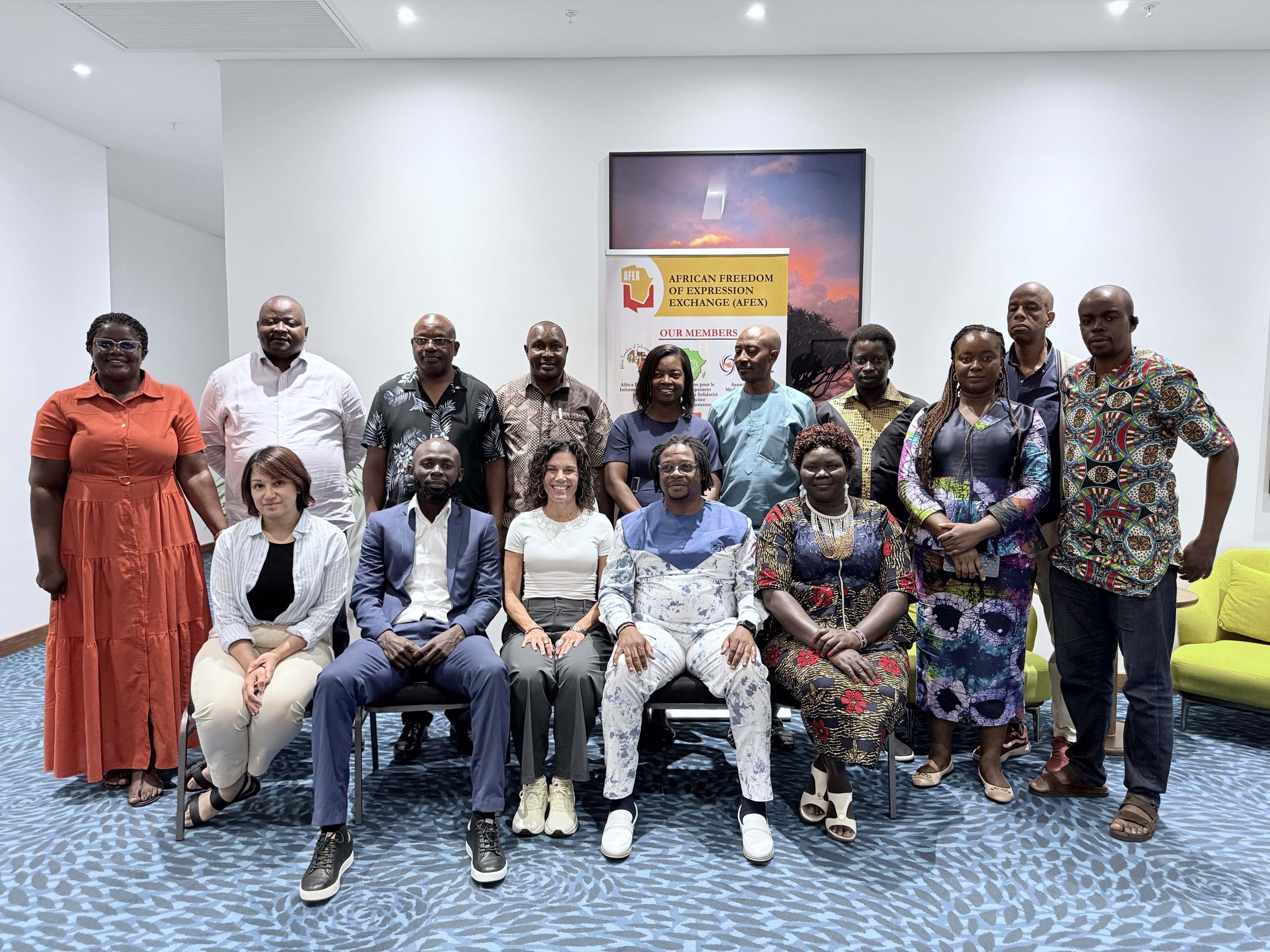
The Eleventh General Meeting of the African Freedom of Expression Exchange (AFEX), a continental network of freedom of expression and media development organisations and members of the global press freedom advocacy network IFEX, was convened at the Hilton Garden Inn, Windhoek, Namibia, on Wednesday, September 24, 2025.
Organized by the Media Foundation for West Africa (MFWA), host of the AFEX Secretariat, and chaired by Paul-Joel Kamtchang, Executive Director of ADISI-Cameroon and Chairperson of the AFEX Steering Committee, the meeting brought together delegates from all 14 member organisations across West, East, Central, and Southern Africa. Also present were representatives from IFEX, including Executive Director Rachael Kay, Advocacy Coordinator Farah Bogani, and Africa Regional Editor Reyhana Masters.
The meeting served as a strategic platform to evaluate the state of media freedom, access to information, digital rights, and civic space across Africa. Delegates presented country reports detailing trends, progress, and setbacks, followed by deliberations on regional collaboration, advocacy, and accountability mechanisms to protect press freedom and democratic participation.
Preamble
Recalling the collective commitment of AFEX to defend freedom of expression and press freedom in Africa, in accordance with Article 9 of the African Charter on Human and Peoples’ Rights and the 2019 African Declaration of Principles on Freedom of Expression and Access to Information;
Recognizing that vibrant, independent media and open civic spaces are central to good governance, transparency, and the realization of human rights;
Concerned by the continuing repression, harassment, and criminalization of journalists and media institutions across Africa, and the widespread misuse of cybercrime, defamation, and national security laws to silence dissent;
Acknowledging the resilience and innovation demonstrated by journalists and civil society organizations in advancing access to information, countering disinformation, and promoting accountability despite hostile environments;
The Eleventh General Meeting of AFEX hereby resolves as follows:
- On Press Freedom and Safety of Journalists
Strongly condemns all attacks, arbitrary arrests, and acts of intimidation against journalists and media houses across Africa, as documented in reports from The Gambia, Liberia, South Sudan, Cameroon, and Uganda, and further denounces the ongoing persecution of journalists in conflict-affected regions of the Democratic Republic of Congo, where media workers have been detained for publishing politically sensitive content and where press coverage is being actively suppressed in both eastern and western parts of the country.
- Notes with grave concern the increasing use of violence, surveillance, and censorship, particularly the torture of journalists in South Sudan, the closure of media houses in Senegal, Benin, and Togo, and the harassment of reporters in Uganda and Nigeria.
- Demands accountability for crimes against journalists, emphasizing that impunity remains one of the greatest threats to press freedom.
- Calls for the establishment of national mechanisms for the safety of journalists, in collaboration with the African Union, the African Commission on Human and Peoples’ Rights (ACHPR), and national media councils.
- Commends the work of Journaliste en Danger (JED) and other civil society actors in the DRC who have successfully lobbied for the release of arbitrarily detained journalists, despite a generally hostile media environment.
- Calls attention to the structural challenges faced by journalists in the Democratic Republic of Congo (DRC) and South Sudan, including poor remuneration, unsafe working conditions, and lack of institutional support, all of which significantly undermine journalistic independence, professional integrity, and personal safety.
- Urges governments to guarantee the protection of women journalists, who face gender-based violence, online harassment, and intimidation, especially at the community media level.
- On Legal and Policy Frameworks
- Notes progress made in some countries, including The Gambia’s repeal of criminal defamation and sedition laws, and the adoption of Access to Information (ATI) laws in Senegal, Botswana, and Somalia.
- Commends the Gambia Press Union (GPU), CEMESP (Liberia), and AFIC (Africa) for leading campaigns that have resulted in legal and institutional reforms.
- Welcomes the legal framework provided by the Muyaya Law in the DRC, which, while inconsistently implemented, has created new avenues for civic engagement and public advocacy on freedom of expression and media rights.
- Expresses concern about regressive legislative trends, such as Uganda’s Computer Misuse Act, Nigeria’s Cybercrimes Act, and South Sudan’s National Security Act, which are being used to suppress dissent and restrict online expression.
- Calls on governments to reform restrictive laws, including defamation statutes and media licensing regimes, to align with international human rights standards.
- Encourages the harmonization of media and information laws across regions, and calls on the ECOWAS Court of Justiceand national parliaments to strengthen oversight and enforcement of press freedom obligations.
- On Access to Information and Transparency
- Reaffirms that the right to access information is a cornerstone of democratic accountability and citizen participation.
- Welcomes the operationalization of Information Commissions in The Gambia and Liberia, but notes implementation gaps, such as the lack of proactive disclosure and delayed responses to information requests.
- Encourages governments to allocate dedicated budget lines for ATI implementation, as proposed in Uganda, and to strengthen monitoring mechanisms.
- Urges media and civil society organisations to intensify public education campaigns that empower citizens to make effective use of ATI laws.
- On Civic Space and Protest Rights
- Expresses alarm over the shrinking civic space and the increasing militarisation of protest policing across Africa, particularly in The Gambia, Uganda, Nigeria, South Africa, Cameroon, where peaceful demonstrators face arrest, intimidation, or violent dispersal, and journalists covering protests are subjected to threats, physical violence, and unlawful detention.
- Calls on governments to respect the constitutional right to peaceful protest, and to ensure that law enforcement agencies act with restraint and professionalism.
- Urges the African Union and subregional blocs such as ECOWAS and SADC to adopt clear guidelines for the protection of civic space and protest rights.
- Calls on DRC authorities to ensure that journalists and civil society actors can participate meaningfully in processes like the Doha peace process, which currently excludes media voices.
- On Digital Rights and Online Freedom
- Raises deep concern over the weaponization of digital laws, online surveillance, and internet shutdowns during elections and protests across Africa.
- Encourages support for the African Commission’s efforts to develop and adopt a Resolution on Access to Data and finalize the Guidelines on Digital Platform Regulation.Calls on states to ensure data protection, online privacy, and freedom of digital expression, especially for journalists, whistleblowers, and human rights defenders.
- Encourages rights organisations to strengthen their engagement in digital rights coalitions, sharing strategies for cyber-safety and online resilience.
- On Gender Equality and Inclusion in Media
- Encourages the adoption of gender-sensitive journalist safety mechanisms and equitable representation of women in media leadership.
- Highlights the disproportionate risks faced by women journalists in South Africa and rural regions across the continent and calls for urgent action to address online abuse, sexual harassment, and threats of violence.
- Calls on donors, development partners, and governments to fund programs addressing gender-based harassment, pay inequality, and online abuse in the media sector.
- On Media Sustainability and Economic Pressures
- Notes with concern the economic fragility of independent and community media, particularly in Liberia, Nigeria, DRC, and The Gambia, where high taxes, advertising bias, and poor remuneration undermine press independence.
- Calls on governments to create fair and transparent media financing frameworks, and on donors to support sustainability programmes for investigative and community journalism.
- Encourages the development of collective bargaining mechanisms and fair labour standards for journalists to strengthen professionalism and welfare.
- On Regional Solidarity, Collaboration, and Accountability
- Encourages increased peer learning, such as study visits, cross-border campaigns, and joint monitoring initiatives on journalist safety across the continent.
- Supports strategic litigation against violations of freedom of expression and access to information, and calls on media rightsorganisations to document and share cases for regional advocacy and accountability.
Conclusion
AFEX reaffirms its unwavering commitment to protecting freedom of expression, promoting media independence, advancing access to information, and expanding civic space across Africa.
AFEX calls upon African governments to respect and uphold these fundamental rights as the foundation of democratic governance, accountability, and social justice.
Adopted this 24th day of September 2025, in Windhoek, Namibia.
